Today the students built alligators. Similar to the dancing birds, they used gears, pulleys, and belts. But today the students were asked to add a motion sensor. The students were challenged to include the sensor on their alligator structures and to add the sensor block to their computer program.
Most of the students had no difficulty building the alligators. When it came to programming the software they felt much more challenged. Several students thought that they had "done it" when they were able to get the mouth of the alligator to go up and down. What they didn't realize was that they had missed the key component, the sensor block. They had no problems getting the alligators mouth to move using loop blocks and the start key but it took much more critical thinking to get the motion sensor to activate the motions of the alligator. Only one group accomplished the task! We were very proud of how the students asked great questions, learned from each other and persevered.
Today we focused on the programming aspect of the WeDo Lego kits. Prior to beginning the lesson, we gave the students some information about a few key programming blocks and then set the challenge. Something that caught my eye as I was circulating, was one of my students was taking notes on a small notepad. Never have I asked the children to take notes... generally they just listen. When I asked this little girl what she was doing, she replied "I am taking notes like a good scientist. It will help me remember the steps!" My heart did a happy dance! This is what is all about... She is was deeply connecting to the big idea of this unit! The Lego is just a tool that we are using to discover what makes a great scientist!
The challenge for today was to rebuild the dancing birds and program them to include a recorded sound, have a background picture and caption. Above is an example, although it is missing a personally recorded sound. We concluded the lesson with "sharing out". One student shared that she had a "problem" getting the loop programming block to work when she put it over two different blocks, a move this way, and a move that way block. As we helped her to understand why she had this program, we pointed out to her that "problems" aren't really bad things. They are in fact, great opportunities to learn something new!
We began today's lesson reviewing what we have learnt so far... see above chart.
Next we challenged the students to:
build 2 signs welcoming visitors to the PNE
both signs must move in opposite directions
each sign must move at a different speed
We also added that they could 'think outside the box' and design their creation any way they wanted.
I was very surprised by how few students decided to take what I perceived to be a simpler route, which would have been to recreate the dancing birds from last week, but instead of a creating birds they would tape signs to where the birds would have gone. Instead, most students went about designing new structures. Initially I worried that they hadn't made the connection between the two tasks being similar, but after observing their engagement with the task, I realized that the motivated to create an original structure to meet the requirements of the challenge was far higher than simply meeting the challenge.
Here are some samples of their creations. The creations were amazing! Only a few met the full criteria of the challenge but in trying new ideas the students took risks and learned about different Lego pieces and how they affected change.
Below are some samples of students reflection on their learning through the WeDo Lego projects.
Predictions were recorded
Results (data) was recorded and next week the students will be challenged to take their knowledge of pulleys and belts and transfer and apply it to a different Lego structure they will asked to build.
This week we continued to explore what good scientist do through the Lego kits (our tools). Again, I assigned the students the task of building the dancing birds once, but I challenged them to explore the pulleys and belts to see if they could get their birds to turn in opposite directions and speed up the rotation of the birds. Initially I showed them some examples and had them make predictions on chart paper about how the changes in the pulleys and belts would affect the dancing birds.
Next they went to work building and investigating and discussing what they were learning.
Although the students discovered that they could program the birds to make noises last week, this week they were even more excited when they realised that there was more than one sound they could program. After everything was put away, they recorded their data in their Lego reflection log books which I will post soon but unfortunately I mistakenly left these at school! Stay tuned for their reflections...
Today Division 5 began working with the WeDo Lego Kits to begin an Inquiry-Based Project that we will be working on this term.
Ms. Garcia, a curriculum coordinator at the district level came and spent the afternoon with us and together with the students in Division 5 and myself, we began working with the Lego kits, using these tools to help us understand our essential question, which is:
What do good scientists do?
We kicked off the lesson reading the book What is a Scientist? by Barbara Lehn.
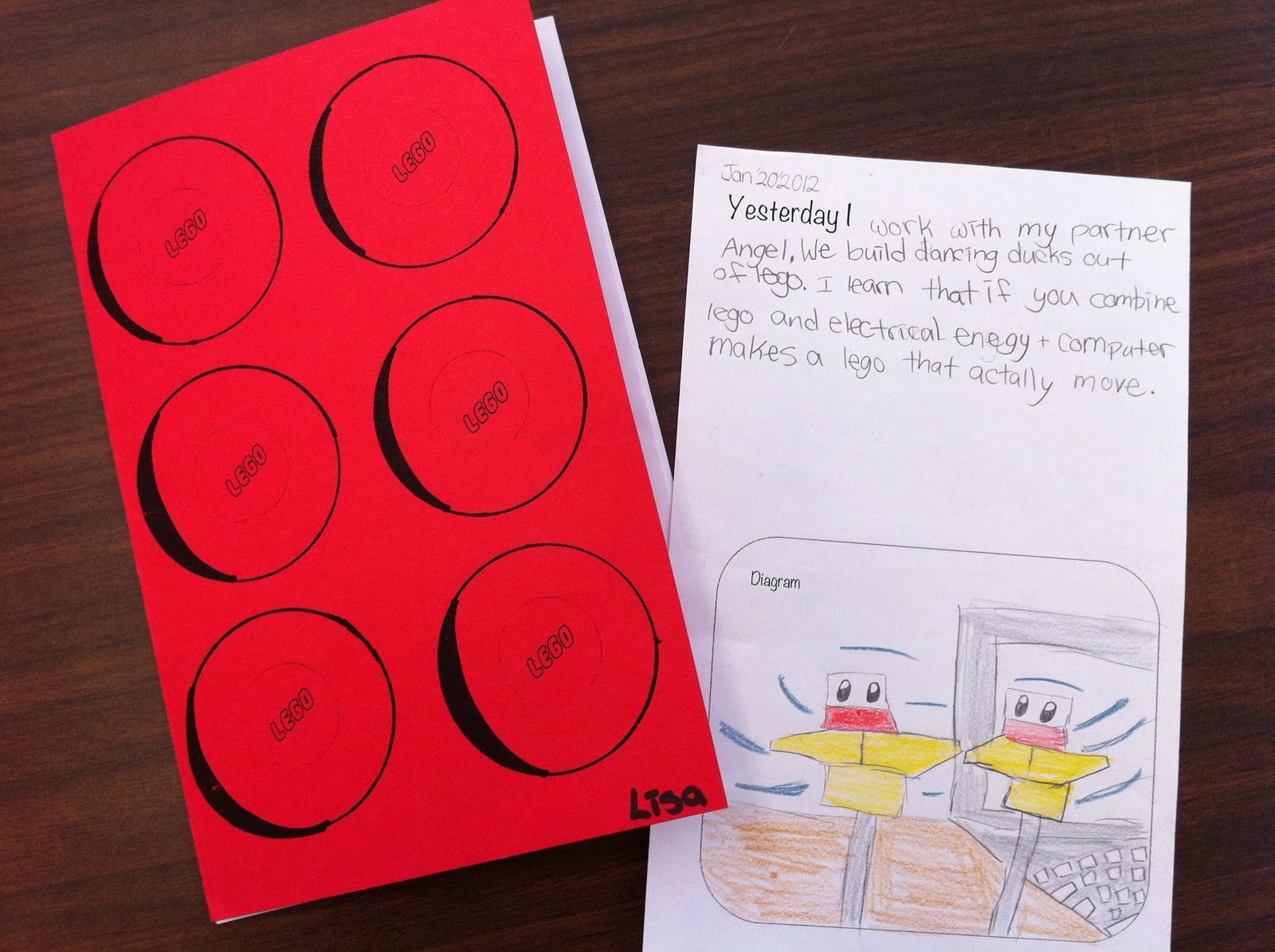
Soon after, the students quickly got to work in partners building "dancing birds". They followed a step-by-step guide booklet.
The students were excited, yet very focussed. In a matter of minutes, they had cooperatively built their ducks. Students persevered through problems and sought out advice from other groups.
Once they finished building, they connected their lego dancing birds to the laptops and began using the WeDo Lego software to program the birds to move and chirp.
When asked what the most important thing they learned during the lesson, students replied:
"How to make lego move using computers!" and "I learned how to program the lego bird with programming blocks".
It was amazing to witness the student's discoveries. One student discovered that when he placed a repeat programming block over top of a motor that way block, he could switch the direction of movement of the lego bird... something unknown even to us, his teachers.
What the students learned was that energy changes from electrical (the computer and motor) to mechanical (physical movement of the gears, pulleys and belts, and axles).
More importantly, they began to explore what makes a good scientist through engaging with the lego in scientific ways. They demonstrated many important scientific skills that we will explore and discuss further into this unit. Today they showed their ability to
perservere
risk take
attend to something with enthusiasm
predict
learn from mistakes (having to take apart and remake their birds)
I look forward to tomorrow when we will work on our Lego Reflection Logs!
 Today the students built alligators. Similar to the dancing birds, they used gears, pulleys, and belts. But today the students were asked to add a motion sensor. The students were challenged to include the sensor on their alligator structures and to add the sensor block to their computer program.