Showing posts with label Fractions. Show all posts

Wednesday, 2 May 2012

I have a question for you!

Hello Division 5 students,

I am beginning to plan my son's Matthew's birthday party.   He is inviting 12 children to his party and I need to figure out how many pizzas I need to order.   A large pizza has 8 slices.   I would like to buy enough large pizzas so that each child can have 3 slices.   How many pizzas do I need to order to have enough slices for all the children?

Can you help me?   Please write your answers in the comment section.

Thanks for your help,   Mrs. Barker :)

Monday, 9 April 2012

Classroom Easter Egg Fun

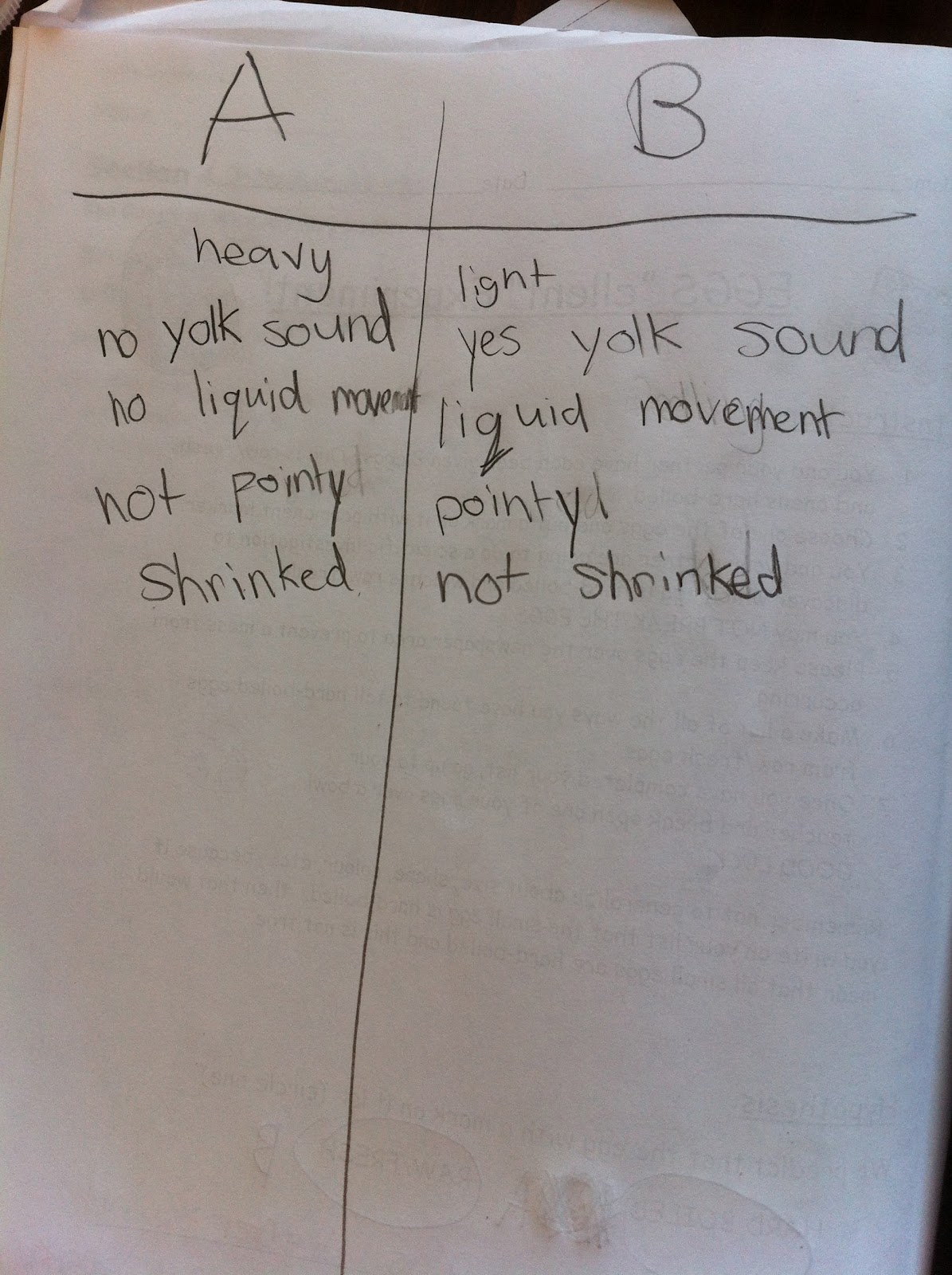
Thursday Division 5 spent doing "Egg-sellent" activities!   Together the students worked cooperatively in groups to discover how to determine whether an egg was hard-boiled or not.

Smelling
Spinning/Observing
Shaking/Listening


Next, we took our eggs outside and played with the strength of an oval.   I instructed the students to use one hand only, and squeeze the egg as hard as they could ~ but they had to apply equal pressure all around (example: don't just press hard with your thumb).   The students were shocked that they could not break the eggs, as we all know eggshells are pretty fragile little things.   But when you squeeze an egg in your hand (all rings must be off), its' strength is amazing.   The strength of an egg lies in its shape.   If you took a sharp object to the side of an egg, it puts pressure on the thin shell and easily breaks it.  But squeezing it directs pressure into the egg, so that it compresses along, not across the shell.

In our structures unit last term, we learned that architects and engineers have used smooth curves, known as arches, to support the weight of structures for centuries.   An arch directs pressure so that it compresses (squeezes) the building material.  An egg is really and amazing piece of natural engineering.


We ended the day, celebrating Easter with jellybeans.   I decided to let the students demonstrate their understanding of a "fair share" or "fractions of a group".  I gave each small group a handful of jellybeans and asked them to figure out how to share them equally amongst each other.   When the task was completed we discussed how the lesson was related to both fractions and division.  Math with food is always full of enthusiasm!


Friday, 6 April 2012

The Doorbell Rang

Last week I read Pat Hutchins book The Doorbell Rang to my class.   The students enjoyed figuring out the mental math in their heads.   It is a story about a mother who makes twelve cookies and asks her children to share them fairly.   After figuring out how many each child will get, the doorbells rings and more kiddies arrive.   As the number of children grows, the students need to re-think how the cookies can be distributed fairly.  The pattern continues throughout the book until their are 12 kids and 12 cookies and then the doorbell rings... and it is Granny bringing more cookies.


Then I taught another wonderful lesson from Marilyn Burns... (although the worksheets were self created).  I explained to the students that they were going to need to work cooperatively in groups to share paper cookies.   We talked about what cooperation looks like and sounds like.   I had 4 groups of four students and 1 group of six students.  

Once the students solved the problem of sharing a specific number of cookies, they brought me their evidence (the worksheet with cut up cookies shared equally) and I would assign them a new challenge to share a different number of cookies.

In the second block of the lesson we met back together as a class and the students shared their answers.  What was wonderful was the connection the students made to equivalent fractions.   Through looking at the multiple ways the students divided up the cookies we could see visually and symbolically equivalent fractions!


Saturday, 31 March 2012

Fraction Photos


This lesson always garners the most attention in the hallways.   Everyone loves to look at photos, especially when they are of our friends.   After reviewing that fractions can be part of a whole and group, we looked at group photos that each student brought to class.  Then we created fraction sentences that depicted our photos.


Wednesday, 14 March 2012

Fabulous Fractions

If you have been following my blogposts at all, I think you have gathered that I LOVE teaching math.  One of my many favourite concepts to teach is fractions.

Last week my students and I did a popular Marilyn Burns lesson that has the students build fraction kits.  Through building the kits, the students concretely understand that fractions can represent equal pieces of a whole.   Next the students using their fraction kits and fraction dice to play a game called Cover Up.  They each took turns rolling the die and if the die read one half, they would take one half and cover part of their whole.   Students continued to take turns until the entire whole was covered.  This game was repeated but this time in reverse, by taking away pieces from a covered whole until nothing was left.


We also played one of Kim Sutton's games called Fraction Match Up, using double dice.  The smaller number rolled on the die represented the numerator and the larger number was the denominator.  Once the fraction was written, the students would search for the matching fraction (in picture format) and would cover it up with a chip.   Similar to Bingo, the first student to cover an entire line was the winner.


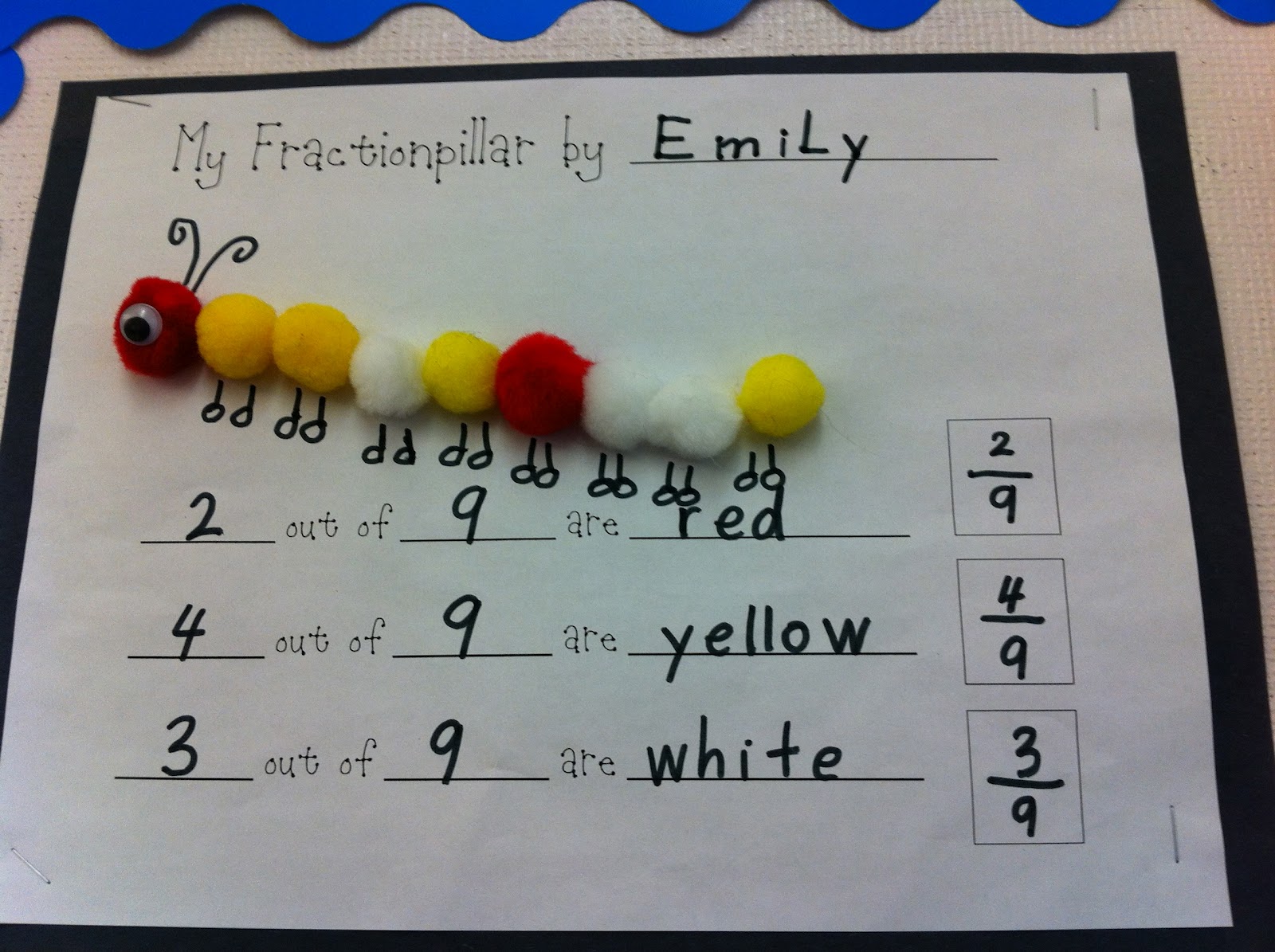
We ended the week talking about fractions that represented parts of a group or set.   I found the idea below on Pinterest and the kids had a ton of fun using the pompoms and glue guns!


 Below is an example of how we used KidsPix to demonstrate our understanding of fractions as equal parts of a whole and fractions of equal parts of a group or set.


I can't wait until we return to school after spring break and can continue our exploration of fractions!